
Definition
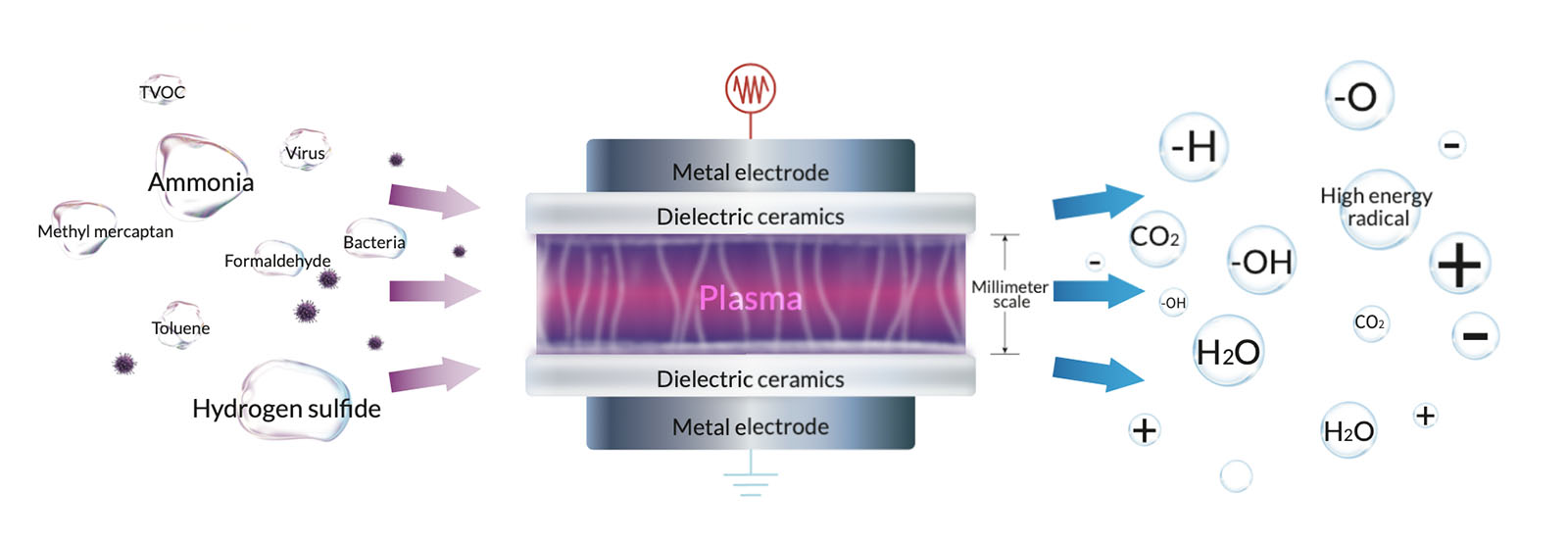
Based on dielectric barrier discharge technology, special dielectric ceramics are used to insulate the metal electrodes, forming millimeter-scale micro-gap discharge channels. This facilitates the high-energy power source to excite energy within the micro-gap channel, generating a large amount of glow plasma.
Working Principle and Technical Features
AIRQUALITY’s micro plasma technology is an efficient deodorization technology. Its working principle is based on Double Dielectric Barrier Discharge (DDBD), a non-equilibrium gas discharge phenomenon. In this technology, an insulating medium is inserted between the discharge electrodes, and when high-voltage AC power is applied to the electrodes, the gas between the electrodes breaks down, forming a uniform low-temperature plasma that efficiently treats malodorous gases. This structure not only makes the equipment simple, easy to operate, and highly stable but also effectively avoids local discharge or arc discharge that may occur during corona discharge due to the presence of the insulating medium, ensuring uniformity and safety in the treatment process. The low-temperature plasma produced has high density and large electron energy. Combined with the full-section airflow design, it achieves high-efficiency deodorization in a single pass. Additionally, this technology has the advantages of energy-saving operation and low operating costs.
Application
Suitable for indoor living environments such as bathrooms, offices, changing rooms, hotel rooms, and pet rooms; public restrooms, garbage disposal rooms, garbage transfer stations, restaurant grease traps, and other odorous places; as well as light-duty deodorization in sewage treatment rooms, sewage pump rooms, municipal garbage treatment plants, and textile printing and dyeing, and papermaking industries.
How does it remove odor?
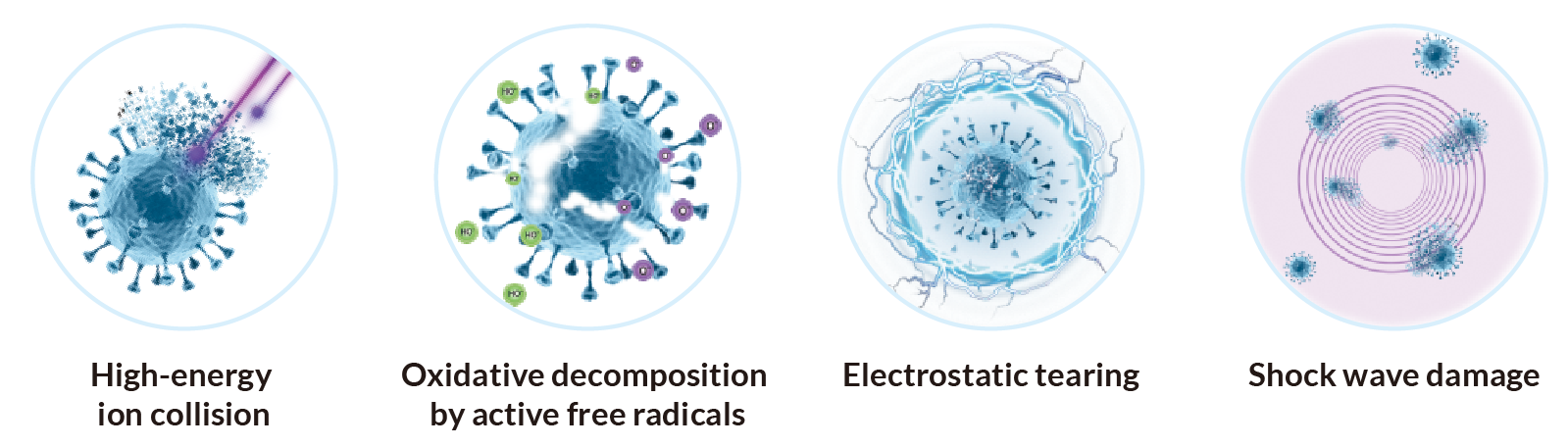
High-energy particle bombardment: High-energy electrons, ions, and photons in the plasma impact and break the chemical bonds such as N-H, H-S, and C-H in odor molecules, achieving ionization, dissociation, excitation, and decomposition of gaseous pollutants like ammonia (NH3), hydrogen sulfide (H2S), methyl mercaptan (CH3SH), TVOCs, formaldehyde (HCHO), and toluene (C7H8).
Active oxidation and decomposition: A large number of active groups such as -O, hydroxyl (-OH), and -H in the plasma undergo a series of complex physical and chemical reactions with odorous gaseous pollutants, breaking them down and eventually converting them into substances like H2O and CO2, thereby achieving exhaust gas purification.
How does it disinfect the air?
Electrons, ions, photons, and other particles in the plasma gain energy in the high-voltage electric field. These high-energy particles can instantly break bacterial cell walls and viral biological structures; simultaneously, elementary reactions occur, producing active radicals and atomic oxygen, directly killing bacteria and viruses.
Competitive Differences
Compared to traditional chemical reagents, activated carbon adsorption, biological agents, and regenerative thermal oxidizer deodorization methods, AIRQUALITY micro plasma technology has the advantages of no consumables, easy maintenance, no secondary pollution, high one time efficiency, rapid removal of large amounts of malodorous substances, and low long-term operating costs. Compared to ordinary plasma technology, AIRQUALITY micro plasma technology offers greater plasma intensity, a broader reaction zone, higher treatment concentrations, faster deodorization, better deodorization effects, and lower power consumption.